

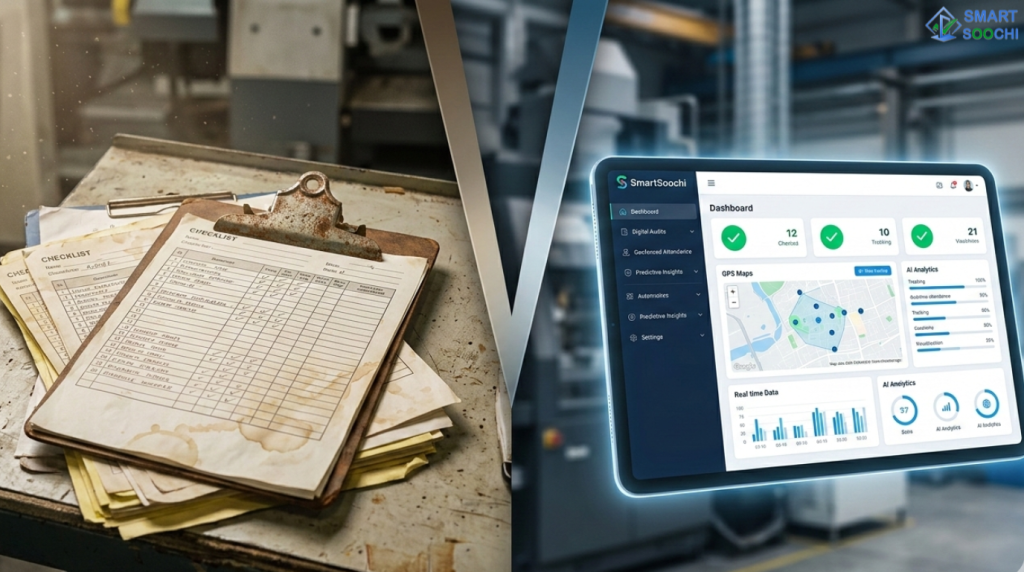
Imagine a supervisor at a manufacturing plant spending two hours every morning manually reviewing paper safety checklists. He finds a smudge on one page, a missing signature on another, and realizes a critical machine check happened three days ago but the report only reached his desk today. This “time-lag” creates a dangerous gap between reality and reporting. Many organizations view paper as a “cheap” or “free” resource, yet the hidden drain on productivity and safety tells a different story. If you want to transform your operations, you must understand how to calculate your digital workflow ROI to justify the switch from clipboards to smart devices.
The False Economy of the “Paper Trail”
Business leaders often stick to paper because it feels tangible and reliable. However, paper is actually the most expensive medium for data. When you use paper, you pay for much more than just the sheet itself. You pay for the printer ink, the physical storage cabinets, and the time employees spend filing or searching for lost documents.
Beyond these visible costs, “dark costs” exist. These include manual data entry errors, the inability to track GPS locations of field staff, and the lack of real-time alerts when a safety breach occurs. A digital workflow ROI calculation accounts for these inefficiencies by measuring how much faster a team completes tasks when they use automated, geo-tagged, and photo-verified checklists.
Step 1: Calculating Direct Cost Savings
The first pillar of digital workflow ROI involves hard costs. Calculate how much your organization spends annually on:
- Paper and Printing: Reams of paper, toner cartridges, and printer maintenance.
- Storage Space: The square footage of office space dedicated to filing cabinets or off-site storage rentals.
- Administrative Labor: The total hours spent by HR or operations teams manually typing paper data into Excel sheets.
SmartSoochi users often report a 70% reduction in manual administrative effort. By digitizing your SOP-based checklists, you reallocate those hours toward high-value tasks like process optimization and strategy.
Step 2: Measuring Productivity Gains
Productivity is where the digital workflow ROI truly shines. In a paper-based system, a technician completes a task and then travels back to the office to submit the report. With a digital system, the report is finished the moment they hit “submit” on their mobile app.
SmartSoochi’s offline-first capability ensures that even in remote areas with no internet, data is captured accurately. Once the device connects to a network, the system auto-syncs. This eliminates “travel time” for data. You can measure this by tracking the “Mean Time to Report” before and after digitization. Most enterprises see a 40% faster fault resolution because supervisors receive instant notifications of failures rather than waiting for a weekly physical audit.
Step 3: Factoring in Accountability and Compliance
How much does a single compliance fine cost your business? Or the loss of a client due to a missed SLA? These risks are high when you rely on “trust” without verification. Paper checklists are easily “back-filled” at the end of a shift, a practice known as “ghost auditing.”
A robust digital workflow ROI includes the value of tamper-proof data. SmartSoochi uses AI-powered facial recognition (Haaziri) and geofencing to ensure the right person is at the right location at the right time. When every checklist submission is timestamped and geo-tagged, you eliminate proxy attendance and fraudulent reporting. This level of “Digital Assurance” protects your brand reputation and ensures you are always “audit-ready” for ISO or regulatory inspections.
Step 4: The Impact of AI and Predictive Insights
The final stage of calculating digital workflow ROI moves from reactive to proactive savings. When your data is digital, AI can analyze patterns. For example, if your digital checklists show a specific machine part fails every 200 hours, the system can trigger a predictive maintenance work order before the breakdown happens.
Reducing unplanned downtime by even 30%—a common achievement for SmartSoochi clients—can result in millions of dollars in saved production revenue. This isn’t just about saving paper; it’s about making your entire operation more intelligent.
Conclusion: Making the Move
Calculating your digital workflow ROI proves that the cost of inaction is far higher than the cost of digital transformation. By ditching the paper chaos, you gain 360-degree visibility, verified accountability, and a scalable platform for growth. SmartSoochi provides the zero-code tools you need to build these workflows today, ensuring your business stays ahead of the curve.
DigitalTransformation #SmartSoochi #OperationalExcellence #PaperlessOffice #SaaSSolutions
