

Navigating the Transition from AI Promise to Pragmatic Scale
Audience: Chief Technology Officers, VP of Engineering, AI Team Leads
Executive Summary
The narrative for 2026 is defined by a critical shift: the “roar” around Artificial Intelligence is quieting, replaced by the high-impact, often unglamorous work of making AI usable at scale1. For technology leaders, 2026 is not about chasing the next viral model, but about inference, integration, and infrastructure.
Key strategic takeaways for 2026 include:
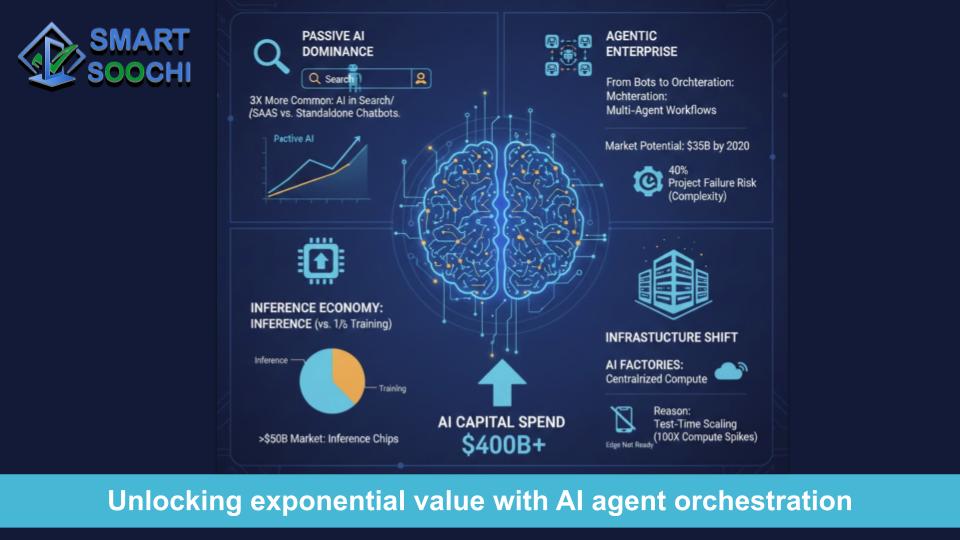
- The Rise of “Passive” AI: Generative AI (Gen AI) adoption will be driven more by invisible integration into existing workflows (like search and SaaS) than by standalone chatbots.
- Inference Domination: The compute workload is flipping. By 2026, inference—not training—will account for two-thirds of all AI computing power.
- The Agentic Enterprise: We are moving from single-task bots to multi-agent orchestration, a market projected to reach up to $45 billion by 2030 if optimized correctly.
- Hardware Reality Check: Despite hopes for edge computing, heavy AI workloads will remain centralized in massive data centers due to the sheer power demands of new scaling techniques
Section 1: The Evolution of AI Usage
From Active Prompting to Passive Utility
The user behavior surrounding Gen AI is undergoing a bifurcation. While standalone tools (like ChatGPT) require skill in prompt engineering, the massive growth in 2026 will come from passive Gen AI—features embedded seamlessly into existing applications.
Key Metric: By 2026, daily usage of Gen AI within search engines (summaries/synthesis) will be 300% more common than usage of standalone Gen AI tools
Adoption Dynamics
- Demographic Shift: While Gen Z dominates standalone tool usage, older generations (Boomers) are adopting passive AI (like search overviews) at a faster rate because it lowers the friction of entry
- The CTO Implication: Do not build solely for “chat” interfaces. Focus on embedding AI as an invisible utility within your product’s existing search, data retrieval, and summary workflows. Users prefer the “one-touch checkout” experience over the “prompt engineering” experience
Section 2: The Infrastructure of 2026
Inference, Power, and the Data Center Crunch
A common misconception is that as models mature, compute will shift to the “edge” (phones/laptops). The data suggests the opposite for 2026.
1. The Inference Flip
Historically, training foundational models consumed the most compute. In 2026, inference (running the models) will overtake training, consuming roughly two-thirds of all AI computing power
2. Why the Edge Isn’t Ready
New scaling techniques—specifically Post-Training Scaling and Test-Time Scaling (long thinking)—require massive computational resources that edge devices cannot provide
- Test-Time Scaling can increase compute usage by 100x for a single query to ensure accuracy and reduce hallucinations
- Consequently, AI workloads will remain in hyperscale data centers or substantial on-premise “AI factories” rather than moving to user devices in 2026
Forecast: The market for inference-optimized chips will grow to over $50 billion in 2026
| Category | 2026 Prediction | Strategic Note |
| AI Capital Ependiture | $400B – $450B globally 14 | >50% of this spend is on chip |
| Enterprise On-Prem | >$50 Billion market 16 | For privacy/sovereignty, enterprises are buying “AI boxes” ($300k-$500k) rather than pure cloud |
| Edge AI | Minimal Impact in 2026 | “Physical AI” and edge processing will grow, but heavy lifting stays centralized |
Section 3: Agentic AI & Orchestration
Unlocking Value Beyond the Chatbot
We are transitioning from “software eating the world” to “TMT eating the world,” led primarily by Agentic AI
The Orchestration Challenge
Standalone agents are useful, but multi-agent orchestration is where exponential value lies. This involves agents interacting with other agents to complete complex workflows without human intervention
- Market Opportunity: The autonomous AI agent market is projected to reach $8.5 billion by 2026 and could hit $35 billion by 2030
- The Risk: Gartner predicts over 40% of agentic AI projects could be cancelled by 2027 due to scaling complexity and unmitigated risks
Proposed Enterprise Architecture for Agents
To survive the “agent sprawl,” CTOs must architect a resilient system consisting of three distinct layers
- Experience Layer: The interface for human-agent interaction, focusing on transparency and “explainability” of agent actions
- Agent Layer: The modular “brain” that selects the right model for the task, manages tools, and orchestrates workflows
- Context Layer: A knowledge engineering foundation (knowledge graphs/ontologies) that gives agents a “small world” model of the business to reduce hallucinations
Section 4: SaaS Transformation
Pricing and Business Models in Flux
As AI agents permeate SaaS, the traditional “seat-based” pricing model is becoming obsolete. If one agent does the work of five humans, charging by the “human seat” breaks the revenue model27.
Predictions for SaaS Leaders:
- Hybrid Pricing: Expect a shift toward outcome-based or consumption-based pricing (e.g., per token, per task completed, or per successful outcome)
- Headless Interactions: Agents are inherently “headless” (no UI). The “user interface” will increasingly become an API call or a voice command, requiring a rethink of UX design
Section 5: Hardware & Physical AI
Robotics and Semiconductors
Industrial Robotics
While the vision of humanoid robots is compelling, 2026 will see evolution, not revolution.
- Installations: Global installed capacity will reach 5.5 million units by 2026
- Humanoids: Shipments of AI-powered humanoid robots for industrial use will be modest, estimated at 15,000 units in 2026, generating ~$210M–$270M
- Catalyst: The emergence of VLA (Vision-Language-Action) models allows robots to understand context and reason, moving beyond rote pre-programming
Semiconductor Supply Chain Fragility
The supply chain for the chips powering this AI revolution is becoming a geopolitical chokepoint.
- New Chokepoints: Export controls are expanding beyond just EUV lithography to include GAAFET (Gate-All-Around) technology, advanced packaging, and even the software tools (EDA) used to design chips
- Advanced Packaging: As designs move to “chiplets” (combining multiple dies), the packaging process itself is becoming a strategic bottleneck, with a market value of over $100 billion by 2026
Section 6: Connectivity & Media
The Battle for Attention and Bandwidth
Satellite Internet (LEO & D2D)
- LEO Growth: By the end of 2026, there will be over 15,000 to 18,000 active satellites in Low Earth Orbit (LEO)
- Direct-to-Device (D2D): While technically impressive, D2D (connecting satellites directly to unmodified smartphones) faces unclear monetization. Spending on D2D capacity will reach $6-$8 billion, but revenue models remain unproven
Short-Form Video & Vodcasts
- Micro-Dramas: Scripted, minute-long serials are exploding. In-app revenue for micro-series is predicted to double to $7.8 billion in 2026.
- Generative Video Risks: The flood of AI-generated video content is expected to provoke a regulatory backlash in the US in 2026, potentially challenging Section 230 protections and forcing mandatory labeling
Conclusion: Strategic Imperatives for the CTO
The “gap” between AI promise and reality is narrowing, but bridging it requires deliberate engineering and architectural discipline.
- Prepare for Sovereignty: Nations are building “Sovereign AI” clouds to protect data and culture. Your architecture must support multi-cloud and data localization to operate globally.
- Orchestrate, Don’t Just Automate: Move beyond simple chatbots. Invest in the Context Layer (data hygiene) to enable reliable multi-agent workflows.
- Rethink Compute: Budget for inference costs rising significantly. Do not bank on edge computing saving you money in 2026; plan for data center or on-premise “AI factory” spend.
- Embrace “Boring” AI: The biggest wins in 2026 will come from invisible, passive AI integrations (search, summaries, workflows) rather than flashy standalone tools.
Next Step: Would you like me to draft a specific “Agent Orchestration Readiness Checklist” based on the Context Layer and Experience Layer requirements outlined in this report?
